Scope an agent-assisted exercise
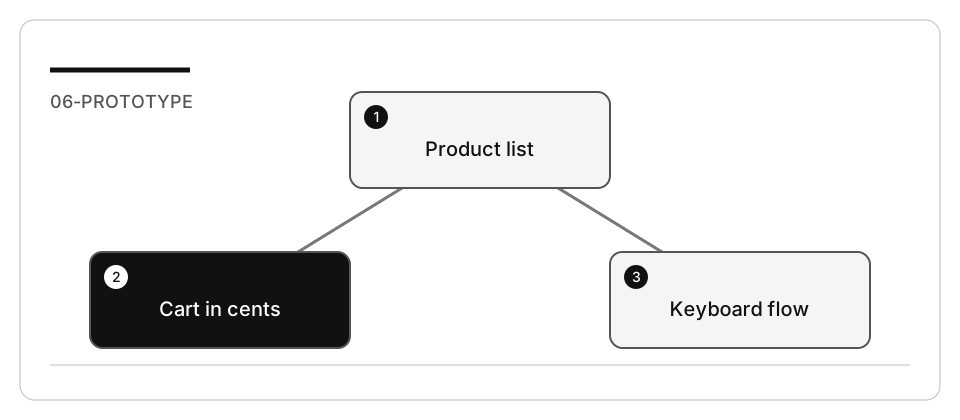
[!TIP] Scope by evidence, not by ambition. Pick one user outcome, one controlled starting point and a result another learner can verify. Use the PRD examples to write that contract.
A useful hands-on lab changes one capability and produces evidence that a learner can inspect. Scope is not a promise that an agent will finish in a particular time.
Choose one kind of work
| Kind | Starting evidence | Example | Exclude |
|---|---|---|---|
| Greenfield | Stakeholder needs and explicit non-goals | RSS subscription list | Background polling, real user accounts |
| Brownfield feature | Existing contract and baseline tests | Document metadata for a dashboard | Unrelated framework migration |
| Refactoring | Characterization tests and current side effects | Extract order validation | Changes to prices or eligibility |
| Modernization | Compatibility contract, data inventory, rollback | CSV storage to SQLite | Rewriting every layer at once |
| Runtime-agent integration | Allowed tools and permission boundaries | Read-only order-status assistant | Unrestricted shell or live payments |
Make the task testable
Replace “make a great shopping site” with:
Build only product listing, details, cart, and a mock summary using the bundled
products. Reuse integer-cents arithmetic. No accounts, tracking, network images,
database, or payment processor. Verify keyboard navigation, quantity errors,
empty cart, and totals at 375px and 1280px viewports.
The exclusions prevent unnecessary dependencies; the cases prevent a polished but unusable result from being mistaken for completion.
Keep useful struggle
Provide the input data and acceptance criteria. Do not prescribe the exact generated code or give a screenshot of “all tests passed” as evidence. Include:
- A baseline inspection.
- A design decision with at least two reasonable choices.
- One deliberately failing case.
- A bounded implementation.
- A negative check that proves the verifier can reject wrong behavior.
- A reset limited to the disposable workspace.
Review scope before implementation
- The exercise can use local synthetic data, or its external dependency is explicit.
- Required tools are separated from optional services and language alternatives.
- The learner knows the working directory and exact baseline command.
- Preserved behavior is stated alongside the requested change.
- The negative case can detect an incorrect implementation.
- Tests have explicit limits; visual appearance is not called complete behavior.
- The stop condition and a safe reset prevent unbounded repairs.
Use the PRD examples to turn these answers into a concrete contract.
Example scope review
| Proposal | Decision | Why |
|---|---|---|
| Build accounts, payments and shipping in one short exercise | Split into separate exercises | Each introduces a different trust boundary and failure model |
| Use three bundled products and a mock checkout | Suitable for the prototype lab | Domain and UI evidence can be observed locally |
| Compare two implementations while changing the dataset | Redesign the comparison | The result cannot isolate the implementation choice |
| Add one boundary test before refactoring one method | Suitable for a focused mission | The learner can explain both the change and its evidence |
Independent practice: write one rejected scope and its smaller replacement. Name which dependency, authority or claim you removed, and which evidence proves the reduced exercise is still useful.
| Previous | Next |
|---|---|
| Learning order | PRD examples |