Prototype an e-commerce interface with GitHub Copilot
Natural-language development still requires engineering decisions. This exercise uses the original shopping prototype scenario, but replaces open-ended generation with a small contract, a working domain module, and observable UI checks.
Lab briefing
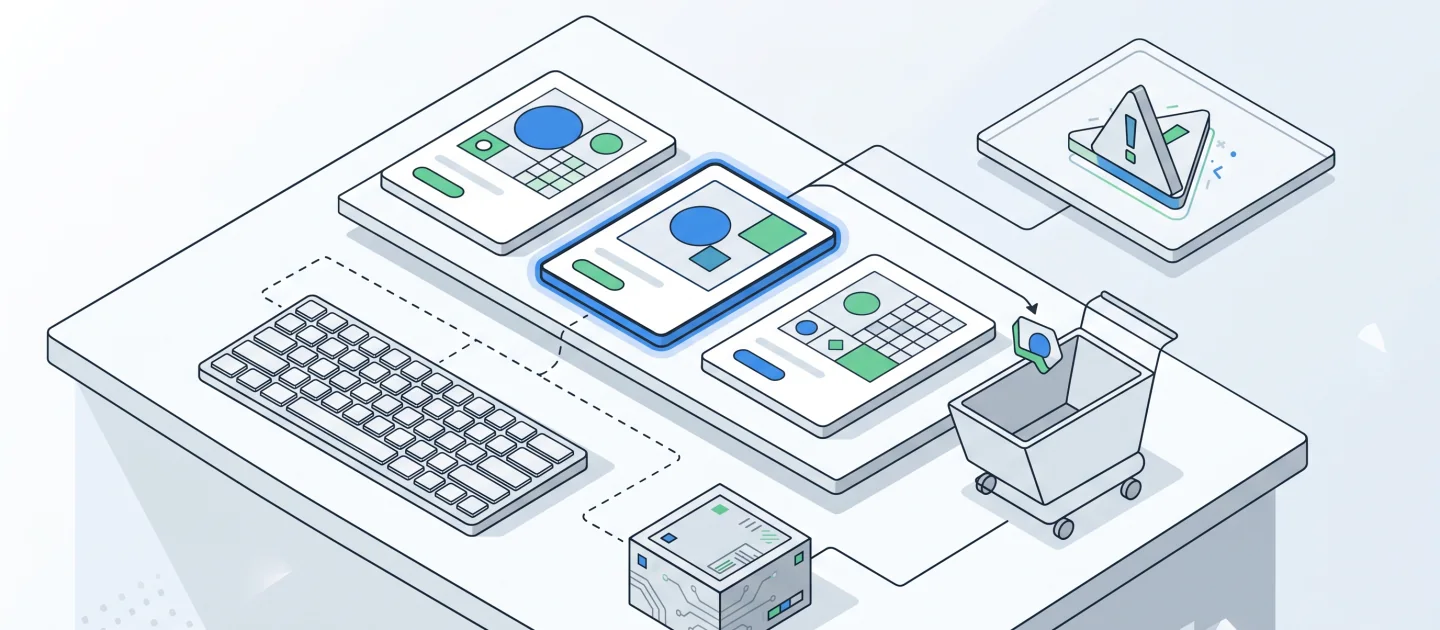
Original concept illustration (SVG)
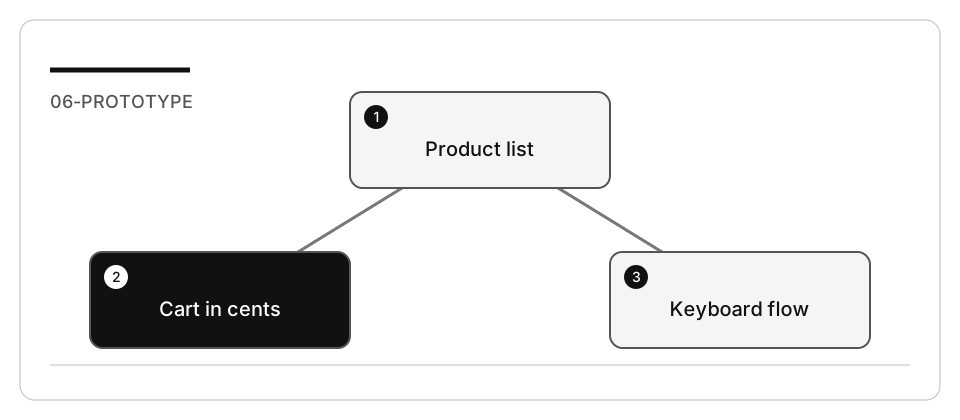
| At a glance | Your route |
|---|---|
| Level and time | 200; 50 minutes (facilitation estimate) |
| Starting action | Write a small PRD and test the UI with only the keyboard. |
| Learner materials | Download 06-prototype.zip |
| Workspace | Open the extracted kit root; run the baseline from . relative to that root |
| Expected initial check | The supplied baseline tests pass. |
| Setup help | Download, extract, local Git and optional GitHub |
[!NOTE] Domain tests do not establish usable focus, labels or viewport behavior.
Concepts · First task · Evidence checklist · Reset
Learning objectives
- Write an achievable PRD with exclusions and acceptance criteria.
- Separate durable engineering instructions from task-specific product requirements.
- Implement a usable interface on top of a tested cart contract.
- Use keyboard, viewport, and error-state checks to challenge generated output.
Before you start
Prepare 06-prototype with the work-drive procedure.
Node 24 is sufficient; do not install a front-end framework or external image package.
Use only the fixture’s synthetic products. Checkout is a simulation, not a payment form.
Concepts and use cases
| Artifact | Contains | Does not contain |
|---|---|---|
| PRD | User goals, behavior, acceptance, non-goals | Claimed test results |
| Wireframe | Navigation and information hierarchy | Business-rule implementation |
| Instructions | Short conventions and validation rules | The entire PRD copied into every request |
| Domain tests | Cart arithmetic and rejected input | Accessibility or visual proof |
Exercise scenario
A shopper browses three products, opens details, adds quantities to a cart, and reviews a mock order summary. No account, analytics, remote assets, persistence, payment processor, or real personal data is required.
Task 1 - Establish the domain baseline
-
Inspect
cart.mjs, its test, and the HTML starter. -
Run:
node --test --test-concurrency=1 cart.test.mjs -
Record that these tests exercise domain rules, not the unfinished UI.
-
In Ask, request a description of valid cart lines and how totals are represented. Verify the answer against the source: currency uses integer cents.
Task 2 - Write the PRD before generating the UI
-
Use the PRD examples.
-
Create
PRD.mdin the disposable workspace with these acceptance criteria:ID Criterion Observable check SHOP-1 List every bundled product Product names and prices are visible SHOP-2 Navigate list, details, cart, summary Keyboard can reach each view and return SHOP-3 Show totals from the domain module Two apples and one banana cost 330 cents SHOP-4 Reject invalid quantities Zero, negative, fractional, and empty quantities show errors SHOP-5 Announce state changes Visible status and an appropriate live region SHOP-6 Show mock checkout only No card, password, or real-address inputs -
Sketch one screen per view. A labeled text layout is enough.
-
Choose meaningful mobile/desktop viewports such as 375 and 1280 CSS pixels. Do not use a 300-pixel breakpoint as the only responsive test.
Task 3 - Review a plan
Use Plan:
Use PRD.md and the existing cart.mjs contract. Plan a framework-free interface.
Identify the views, DOM state, labels, focus transitions, error messages, and
keyboard/viewport checks. Keep currency arithmetic in cart.mjs. Do not implement yet.
Approve the smallest implementation. Reject real checkout, remote tracking, unrelated dependencies, or a new pricing implementation that duplicates the tested module.
Task 4 - Implement one view at a time
- In Agent, implement the product list and details view first.
- Review the diff and test navigation before adding cart controls.
- Reuse
summarizeCartfor totals; render user-visible strings with safe DOM APIs. - Add cart and mock confirmation views. Require accessible names and focus handling.
- Put only conventions in
.github/copilot-instructions.md; linkPRD.mdas context for this task instead of copying its entire contents into instructions. - Stop after two failed repairs to inspect the smallest broken behavior.
Task 5 - Observe the running prototype
-
Start the provided loopback-only server:
node serve.mjs -
Open the printed URL. It uses an OS-assigned port to avoid other projects.
-
Perform the SHOP-1 through SHOP-6 checks manually.
-
Repeat using only keyboard navigation and both selected viewports.
-
Deliberately try a quantity of zero and confirm an error rather than a silent reset or an incorrect total.
-
Re-run the domain tests and inspect the browser console. Record actual results.
Verify your work
- Domain tests still pass, including rejected input.
- Every PRD acceptance criterion has a browser observation.
- No real transaction, credential, tracker, or remote asset was introduced.
- Keyboard focus remains visible and usable after navigation.
- No success is claimed solely because the page looks plausible.
Troubleshooting
| Symptom | Check |
|---|---|
| Module import fails from a file URL | Use the provided local server |
| Total differs by a cent | Reuse integer-cents arithmetic instead of floating-point display values |
| Cart controls are unreachable | Inspect semantic controls, labels, tab order and focus |
| Mobile layout overflows | Test the actual viewport and long product names, not only window resizing |
Independent practice
Add a name filter with a no-results state. Specify whether case and surrounding whitespace matter, then test those cases. Keep it client-only.
Reset
Stop serve.mjs with Ctrl+C, save evidence, and restore only the UI files you
changed in the disposable copy. Do not remove or stop another project’s server.