PRD examples and acceptance contracts
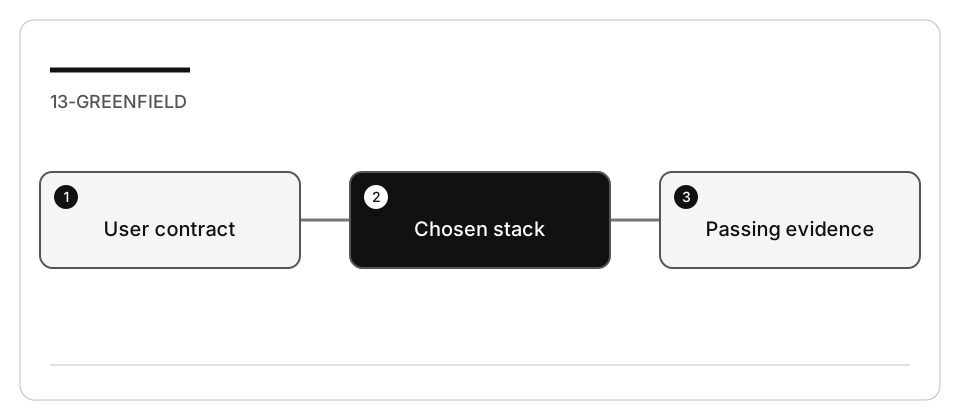
[!TIP] Use this page before asking for implementation. Choose one example, adapt the user and scope, and turn its acceptance rows into checks. Do not paste the entire document into always-on repository instructions.
| If your situation is… | Use… | Practice next |
|---|---|---|
| No working application exists | Example A: new subscription behavior | Greenfield lab |
| Existing behavior must keep working while a feature is added | Example B: metadata delta | Brownfield lab |
| The technical implementation changes, not the user contract | Example C: storage modernization | Modernization lab |
A product requirements document describes why and what. A technical plan describes how. Tests and recorded observations establish whether the result meets the requirements; neither document establishes success by itself.
Work through one requirement
Consider “let readers add feeds.” It is too broad to implement or review reliably.
- Name the user and outcome: a reader wants to curate a local subscription list.
- Bound the behavior: add and list URLs; no network fetch, account or polling.
- Choose one acceptance case: adding the same normalized URL twice must be rejected.
- State observable evidence: the second operation returns an error and the list still contains one entry.
- Identify an unresolved choice: whether URL fragments participate in uniqueness.
- Resolve that choice before writing the plan and tests.
| Weak requirement | Testable replacement |
|---|---|
| The app should be smart and fast | Name a specific workflow and measured constraint, or omit the unsupported speed claim |
| Handle all errors | Enumerate blank, malformed, duplicate and wrong-owner cases that matter to this scope |
| Add secure uploads | Separate file validation, ownership, storage and malware handling; do not call metadata registration a secure upload feature |
| Modernize without breaking anything | Name the exact output, ordering, integer precision and rollback contracts to preserve |
Minimal template
| Section | Required content |
|---|---|
| Problem and user | Who needs the capability and why |
| Scope | One primary workflow and explicit exclusions |
| Acceptance | IDs, given/when/then cases, expected observables |
| Constraints | Data boundaries, accessibility, compatibility, resource limits |
| Risks and questions | Unknowns that must be resolved before implementation |
| Evidence | Exact checks and artifacts; leave unexecuted results blank |
| Change control | Who accepts a scope change and how it updates tests |
Example A - Greenfield RSS subscriptions
User: a reader curating a small local subscription list. Goal: add and list feed URLs without fetching remote content. Excluded: authentication, feed parsing, polling, real user data, persistent storage.
| ID | Given / when | Then |
|---|---|---|
| RSS-1 | A valid HTTPS feed URL is added | Return a stable ID and retain it in the current process |
| RSS-2 | The same normalized URL is added twice | Reject the duplicate; do not silently create another record |
| RSS-3 | Blank, malformed, or non-HTTP(S) URL is added | Reject it without modifying the list |
| RSS-4 | The list returned to a caller is modified | The internal store remains unchanged |
Example B - Brownfield document metadata
User: a staff member finding project documents in an existing dashboard. Goal: register metadata first, preserving the health/project contract. Excluded: binary uploads, public sharing, malware scanning, real employee data.
| ID | Given / when | Then |
|---|---|---|
| DOC-1 | Existing project listing is requested | Preserve IDs and response shape |
| DOC-2 | Valid metadata for a known project is registered | Return an ID and allow listing for that project |
| DOC-3 | A missing project or invalid title is submitted | Return a documented error without partial state |
| DOC-4 | Listing results are changed by a caller | Stored metadata is not mutated |
Example C - Modernize an order ledger
User: an operator who depends on the existing JSON CLI output. Goal: replace CSV reads with SQLite while preserving observable behavior. Excluded: new prices, status rules, HTTP endpoints, accounts, or production data.
| ID | Given / when | Then |
|---|---|---|
| MOD-1 | The same fixture is read by old and new storage | Identical ordered records and totals in integer cents |
| MOD-2 | An invalid or duplicate row is migrated | Nonzero failure; no successful partial database |
| MOD-3 | Migration is rerun against an existing target | Refuse overwrite and preserve the existing file |
| MOD-4 | Rollback selects the CSV reader | Original file and output remain available |
Stack choice is a planning decision
Keep acceptance criteria the same while comparing:
- .NET Minimal API and a small Blazor UI;
- Node/TypeScript and browser-native HTML/CSS;
- Python and its standard-library storage tools;
- Go’s
net/httpfor an independent implementation.
Do not claim all alternatives were executed. Record the chosen stack and the tests actually run. See the Spec Kit labs for implementation and modernization workflows.
Ready for planning?
- One user and primary workflow are named.
- Non-goals prevent unrelated generation.
- Acceptance IDs describe observable results, not implementation preferences.
- Invalid inputs and failure side effects are explicit.
- Existing compatibility is frozen where applicable.
- Open questions are resolved or visibly block implementation.
- Evidence fields remain blank until checks are actually executed.
These examples are compact starting contracts. The full labs add their own requirements and tests; do not assume the four rows on this page exhaust them.
| Previous | Next |
|---|---|
| Scope an exercise | Choose a lab kit |