Examine Copilot settings and interaction boundaries
Do not memorize the position of a button. Learn which control changes the role, which changes the runtime, and which changes permission to act.
Lab briefing
Original concept illustration (SVG)
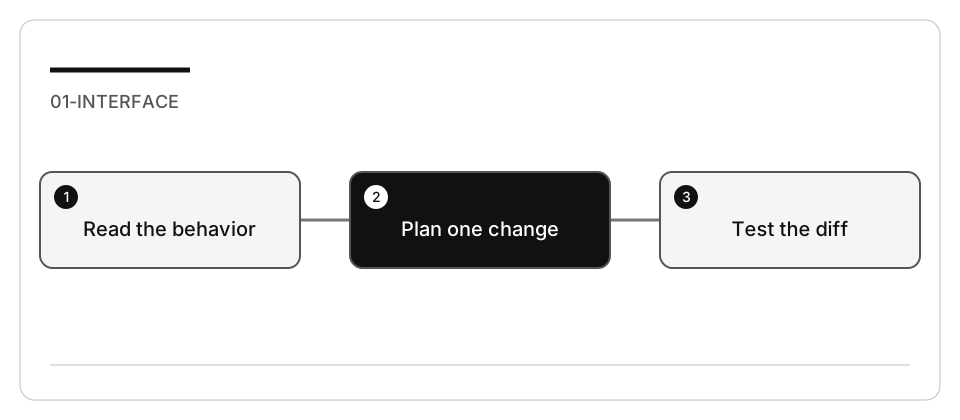
| At a glance | Your route |
|---|---|
| Level and time | 100; 35 minutes (facilitation estimate) |
| Starting action | Run the two original tests before asking Copilot to change the function. |
| Learner materials | Download 01-interface.zip |
| Workspace | Open the extracted kit root; run the baseline from . relative to that root |
| Expected initial check | The supplied baseline tests pass. |
| Setup help | Download, extract, local Git and optional GitHub |
[!NOTE] Approving an answer is not the same as reviewing a change.
Concepts · First task · Evidence checklist · Reset
Learning objectives
- Identify role, harness/target, model, context, and permissions independently.
- Compare explanation, design, implementation, and inline suggestions.
- Validate one small change without broadening authority.
Before you start
Complete Copilot setup and
read the concepts reference.
Prepare 01-interface using the work-drive procedure.
The tiny Node fixture requires no package installation.
Concepts and use cases
| Interaction | Appropriate use | Not proof of |
|---|---|---|
| Ask | Trace behavior and explain code | Correctness of a generated implementation |
| Plan | Define a safe change and checks | Files being changed |
| Agent | Implement with permitted tools | Every command requiring manual approval |
| Inline completion/NES | Accept or reject a local suggestion while editing | A complete repository refactor |
| Semantic rename | Rename one symbol across references | A change to its runtime behavior |
Tool approval depends on your policy, not on whether a screenshot shows a Continue button. Only approve a command after reading its target, side effects, and scope.
Exercise scenario
The fixture formats a short welcome message. The requested change is to trim a name before formatting it while retaining the existing empty-name error.
Task 1 - Establish the starting behavior
-
Open the prepared workspace and inspect
greeting.mjsandgreeting.test.mjs. -
Run:
node --test --test-concurrency=1 greeting.test.mjs -
Record the output and exit status. A missing runtime is an environment failure, not a test of the greeting implementation.
-
Inspect the session target, role, model, and allowed tools. Keep unrelated MCP servers and background sessions out of this exercise.
Task 2 - Explain with and without explicit context
-
In Ask, request:
Explain how a blank name is handled. Do not edit or run commands. Cite the file and branch that support your answer. -
Record whether the agent retrieved files itself or lacked evidence. Do not assume that removing an attachment makes the file inaccessible.
-
Attach
greeting.mjsexplicitly and repeat. Compare correctness and cited evidence, not response length or confidence. -
Confirm that the exercise request did not change files.
Task 3 - Plan a small, risky boundary change
-
Select Plan in a supported session.
-
Submit:
Trim the name before producing the greeting, without changing the error for blank or non-string input. Identify whitespace and wrong-type cases, affected files, the test command, and a one-change rollback plan. Do not edit. -
Challenge any missing case:
" Ada ",""," ",null, and a number. -
Approve only the bounded plan. Plan is useful even for a two-line change.
Task 4 - Implement and inspect
- Hand the reviewed plan to Agent.
- Allow only changes to the greeting implementation and its tests.
- Review the diff before accepting it. Test weakening is not an acceptable fix.
- Run the same test command yourself and add the missing whitespace case if it was not already covered.
- Change one expected assertion deliberately, verify a nonzero result, then restore that assertion. This proves the test can reject wrong behavior.
Task 5 - Compare inline assistance
- In a separate scratch file, begin writing a similar greeting function.
- If inline suggestions are available, accept one and reject another. If none appears, record it; do not invent a suggestion.
- Compare a manual symbol rename with next-edit suggestions.
- Restore any language-specific preference you changed. Do not modify account- wide privacy settings or undocumented advanced engine URLs for this lab.
Verify your work
- Baseline and after-change test outputs are recorded.
- A negative assertion produces nonzero exit.
- Role, target/harness, environment, model and permissions are not conflated.
- Ask/Plan evidence is separate from the Agent diff.
- No setting change leaks into other workspaces.
Troubleshooting
Use Command Palette names rather than screenshot coordinates. For missing context, inspect references and permissions. For a missing target, check policy and current client support. Old Ask/Edit screenshots are historical, not the current curriculum.
Independent practice
Repeat the change using a different available harness. Compare the actual tool list, instruction discovery, and validation output. Do not claim a speed improvement from a single trial.
Reset
Restore only the two exercise files from your disposable baseline, close the scratch file, and start a fresh session. Keep all original repository files untouched.