Customize Copilot for a bounded inventory task
Instructions influence responses; they do not enforce permissions. A custom agent
defines a role/tool profile; its target metadata does not mean “run in the cloud.”
Select execution through the actual session target control.
Lab briefing
Original concept illustration (SVG)
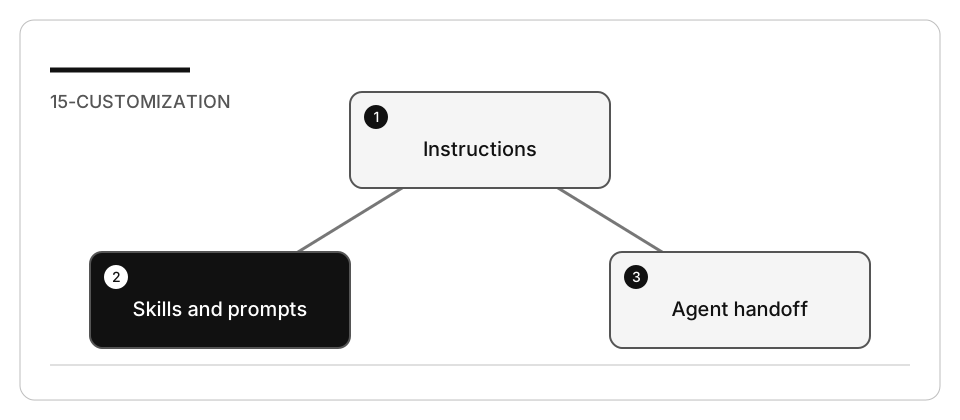
| At a glance | Your route |
|---|---|
| Level and time | 300; 80 minutes (facilitation estimate) |
| Starting action | Verify discovery and test the inventory change separately. |
| Learner materials | Download 15-customization.zip |
| Workspace | Open the extracted kit root; run the baseline from . relative to that root |
| Expected initial check | The supplied baseline tests pass. |
| Setup help | Download, extract, local Git and optional GitHub |
[!NOTE] A file existing on disk is not proof that the host loaded it.
Concepts · First task · Evidence checklist · Reset
Learning objectives
- Use the smallest customization primitive for each need.
- Verify discovery from a disposable workspace root.
- Distinguish instructions, task prompts, skills and handoffs.
- Implement one inventory change without assuming customization guarantees correctness.
Before you start
Prepare 15-customization using the common setup.
The bundled Node inventory fixture needs no package install and replaces a mandatory
external Blazor/database project. A C# service/controller adaptation is optional.
Read the concepts reference.
Concepts and use cases
| Need | File | Verification |
|---|---|---|
| Durable conventions | .github/copilot-instructions.md |
Discovered/applied context and compliant diff |
| Test-specific rules | .github/instructions/tests.instructions.md |
applyTo matches test paths |
| Manual review task | .github/prompts/review-change.prompt.md |
Invocation in a supported Local session |
| Reusable verification expertise | .github/skills/check-evidence/SKILL.md |
Discovery and relevant use |
| Read-only planner | .github/agents/planner.agent.md |
Tool list lacks edit/execute authority |
| Implement/review workflow | Handoffs between profiles | Human reviews the prefilled prompt |
Exercise scenario
The fixture lists inventory categories. Add an item lookup by exact SKU, retaining the category contract and returning copies. Do not add persistence, authentication, cloud deployment, or a whole CRUD application.
Task 1 - Establish the baseline and workspace boundary
node --test --test-concurrency=1 inventory.test.mjs
Open only the copied fixture as the workspace root. Capture the selected role, harness, model and permission state. A customization file buried in another workspace is not proof it loaded.
Task 2 - Create focused instructions
-
Create
.github/copilot-instructions.mdwith a short project description: integer quantities, immutable return values, standard library only, focused tests. -
Create a path-specific file:
--- applyTo: "**/*.test.mjs" --- Use node:test and node:assert/strict. Test invalid and missing IDs. A passing test must call production code and assert observable behavior. -
Inspect the current customization discovery UI/references for the chosen host.
-
Attach one test file and ask which guidance applies.
-
Do not create conflicting instructions to “test precedence”: VS Code does not promise a combination order. Resolve contradictions explicitly.
Task 3 - Compare a prompt and a skill
-
In Local, create a prompt using
agent: askand read/search tools:--- description: Review an inventory change against its acceptance criteria. agent: ask tools: [read, search] --- Inspect the selected change and tests. Report missing cases with source paths. Do not edit files or claim tests ran unless their output is available. -
Invoke it and record how it differs from automatic instructions.
-
Create a
check-evidence/SKILL.mdwith frontmatternameanddescription, followed by steps to select/run existing checks and report actual evidence. -
Inspect skill discovery in the Copilot harness when available.
-
Do not expect the prompt file to run on Agent Host; do not copy its whole text into always-on instructions as a workaround.
Task 4 - Define a planner and a bounded handoff
Create .github/agents/planner.agent.md:
---
name: inventory-planner
description: Plan a small inventory change without editing source.
tools: [read, search]
handoffs:
  - label: Implement reviewed plan
    agent: agent
    prompt: Implement only the reviewed inventory slice and run its focused tests.
    send: false
---
Inspect current source and tests. State acceptance criteria, files, checks and
non-goals. Do not edit, execute commands, or invent validation results.
Inspect the profile and tools in the host. Tool names/aliases and handoffs differ
across surfaces; use the documented picker rather than adding guessed tool names.
Do not set target: cloud: that is not the documented execution mechanism.
Task 5 - Complete a reviewed change
- Ask the planner to specify
findBySku(sku)with found, missing, invalid and copy-isolation cases. - Review the plan and the prefilled handoff prompt before sending.
- Let Agent implement only that feature and its tests.
- Review in a clean read/search-only session.
- Run the full small fixture test file yourself.
- Compare actual compliant behavior with the mere existence of instruction files.
Check yourself
Your instructions file requires immutable return values, but the implemented findBySku returns a live reference. What does that tell you?
Choose an answer to see why it holds or fails.
- Instructions only influence the output, so the diff and the test run are the real proof of compliance. The lab tells you to compare actual compliant behavior with the mere existence of instruction files, and to inspect context and tests.
- The file was not discovered, because a loaded instructions file is applied as a hard rule. Discovery and compliance are separate; a discovered file still only influences responses and does not enforce permissions or conventions.
- The rule was too weak, so a second and stricter instructions file would make it binding. The lab warns against conflicting instructions because VS Code does not promise a combination order, so this adds ambiguity, not enforcement.
Verify your work
- Customizations are discovered from the copied root.
- Instructions and prompts are not conflated.
- The planner has no edit/execute tools.
- Handoff is human-reviewed; unavailable features are recorded.
- New item lookup and old category behavior are both tested.
- No customization is described as a sandbox or deterministic policy.
Troubleshooting
If the profile is absent, inspect workspace root, filename and frontmatter. If a tool is unavailable, choose a supported alias rather than granting all tools. If the implementation ignores a convention, inspect context and tests; do not claim instructions enforce it automatically.
Independent practice
Adapt the same conventions to a C# inventory service and test project. Explain which
rules are cross-stack and which applyTo patterns/tool names must change.
Reset
Save redacted discovery evidence. Close the copied workspace and its agent sessions.
Restore only exercise customizations/source in that copy, never the curriculum’s
shared .github directory.