Refactor existing C# library code safely
Replacing a loop with LINQ is not automatically an improvement. The refactor must preserve comparison, ordering, null behavior, populated references and side effects.
Lab briefing

Original concept illustration (SVG)
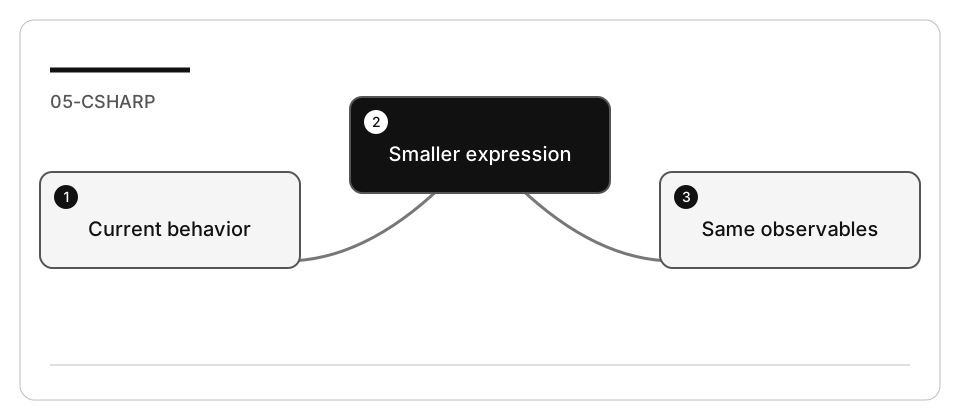
| At a glance | Your route |
|---|---|
| Level and time | 300; 60 minutes (facilitation estimate) |
| Starting action | Characterize one method before replacing its loop. |
| Learner materials | Download 05-csharp.zip |
| Workspace | Open the extracted kit root; run the baseline from . relative to that root |
| Expected initial check | The supplied tests pass. New feature requirements still need their own tests. |
| Setup help | Download, extract, local Git and optional GitHub |
[!NOTE] Shorter code is not evidence of semantic equivalence.
Concepts · First task · Evidence checklist · Reset
Learning objectives
- Derive current behavior from the repository methods.
- Separate refactoring from bug fixes and new search semantics.
- Prove equivalence at selected boundary cases.
Before you start
Prepare 05-csharp using the setup guide.
Use the bundled
C# refactoring fixture.
Do not change dependency versions during a refactor.
Concepts and use cases
| Behavior | Preservation question |
|---|---|
SearchPatrons |
Does Contains remain case-sensitive as in this fixture? |
| Sort | Is the current comparison/culture behavior preserved? |
| Populate | Are related loans still attached? |
GetPatron |
Is absent-ID behavior still null? |
| Update | Are the same fields persisted and reloaded? |
Exercise scenario
The repository uses manual iteration to find and filter patrons/loans. Simplify one method while keeping the existing interface and result semantics.
Task 1 - Inspect and characterize
-
Read
JsonPatronRepository,JsonLoanRepository,JsonData, and their interfaces. -
Run the small fixture suite:
dotnet test tests/UnitTests/UnitTests.csproj -m:1 -p:UseSharedCompilation=false -
Add characterization cases before editing: found/missing, empty list, mixed case, duplicate display names with distinct IDs, and populated references.
-
Use isolated data; do not mutate distributed JSON to obtain expected results.
Task 2 - Ask for alternatives, then Plan
Compare the current loop in SearchPatrons with a LINQ alternative. Preserve
comparison and sort semantics, missing-input behavior, and populated loans.
Identify any material difference; do not edit or claim a speedup.
Choose one method. Require a before/after behavior table and a focused test command. If the current behavior is undesirable, document a separate feature instead of changing it under the name “refactoring.”
Task 3 - Implement one equivalent slice
- Ask Agent to simplify the chosen method only.
- Inspect deferred execution versus materialized lists. Do not return a lazy iterator where callers expect a snapshot.
- Run focused characterization and the original suite.
- Temporarily alter case comparison or omit population. Confirm a regression fails, then restore the refactor.
- Review public signatures and save/reload calls for unintended changes.
Verify your work
- Existing tests and new characterization cases pass.
- Case, ordering and null semantics remain explicit.
- Related entities are still populated.
- Update/persistence side effects are unchanged.
- A deliberate semantic mutation is detected.
Troubleshooting
If tests pass with or without population, improve the assertions. If a sort changes on another machine, inspect culture rather than calling it random. If a missing ID starts throwing, that is a behavior change needing its own acceptance criteria.
Independent practice
Apply the same approach to one loan lookup. Explain when the simpler loop is preferable to a chain of LINQ operators.
Reset
Save the behavior table, restore only the refactored and test files in the copied project, and stop the console if it was started. Never hard-reset the curriculum.